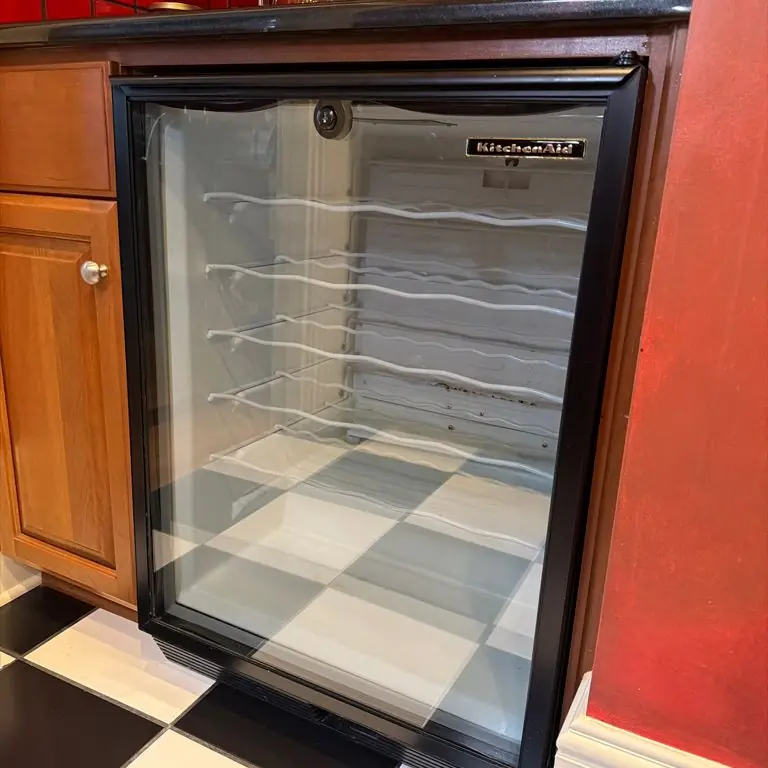
KitchenAid undercounter wine cooler with a glass door and visible bottle racks

BUILT-IN · FREESTANDING · SINGLE & DUAL ZONE

Wine Cooler Repair in Charlotte, NC

A good wine cooler holds the same temperature day after day, without much noise. When yours starts drifting, fogging up or rattling, we send a technician to your Charlotte home to find the fault and fix it. Built-in or freestanding, single or dual zone, we repair wine fridges of every common style. Charlotte summers are tough on them, too: a thermoelectric unit in a room much above 80°F often can't hold 55°F at all.

Same-day appointments available throughout our service area. Every repair comes with a 90-day parts and labor warranty.

6 Common Wine Cooler Problems and How We Fix Them

For each symptom you'll see the usual causes and what our technician checks first. Pick yours:

  1. Wine cooler not cooling

    Usual causesA failed condenser or evaporator fan, a dirty condenser, a compressor that won't start, or a weak thermoelectric module. A thermoelectric unit in a hot room may simply be past its limit.

    What we checkWe measure the real cabinet temperature, make sure every fan spins and test the cooling system your model uses, compressor or thermoelectric.

  2. Temperature swings

    Usual causesA drifting temperature sensor, a blocked vent, or a unit that can't get rid of its heat, often a freestanding model built in under a counter. Frequent door openings in a warm room make it worse.

    What we checkWe compare the display with a probe thermometer and check airflow through the front grille and around the cabinet.

  3. Noisy fan

    Usual causesWorn fan bearings, a blade catching on frost, a loose fan shroud or a condenser fan caked with dust.

    What we checkWe find which fan is making the noise, clean the condenser area and replace the motor if the bearings are worn.

  4. Condensation or leaking

    Usual causesA blocked drain line, an overflowing drip tray or a door that doesn't seal. In a humid Charlotte summer, the glass on a zone set very cold can also sweat on the outside.

    What we checkWe clear the drain path, inspect the tray and make sure the door closes tight against the gasket.

  5. Display or control problems

    Usual causesA failed control board, a faulty touch panel, a loose wiring harness or a bad temperature sensor. A surge when the power comes back after a storm can also damage the board.

    What we checkWe test the board's inputs and outputs before replacing it, so you don't pay for a part that wasn't the problem.

  6. Worn door seal

    Usual causesA torn, flattened or shrunken gasket, a sagging glass door or a hinge that has worked loose.

    What we checkWe inspect the seal all the way around, adjust the hinge and replace the gasket if it no longer seals. Quick test at home: close the door on a dollar bill. If it slides out with no drag, the seal is weak.
Built-In vs. Freestanding Wine Cooler Repair

Inside, both use similar cooling parts. The difference is where the heat goes, and that shapes what tends to fail and how we get to it.

Built-in and undercounter

Made to sit flush with your cabinets and breathe through the grille at the toe kick. When that grille gets blocked by a rug, trim or a layer of dust, the unit can't shed heat, and that's one of the most frequent reasons a built-in runs warm.

  • Cleaning the front grille and condenser
  • Fan service from the front where the design allows
  • Door alignment with the cabinet panels

Freestanding

These push heat out the back or sides and need open space around them. Squeezed into a tight nook, a freestanding cooler can run nonstop and still miss its temperature. Many also end up in garages or sunrooms, where Charlotte's summer heat pushes them past their rated range.

  • Clearance and placement check
  • Rear condenser and fan service
  • Thermoelectric module and power supply testing

We service wine coolers from Wine Enthusiast, Sub-Zero, Viking, Liebherr and many other brands. For high-end units, see our Sub-Zero and Viking refrigerator repair pages. We're an independent repair company and aren't affiliated with any appliance manufacturer.

Wine Cooler Repair Questions

Have a different question? Call (704) 408-3601.

What temperature should my wine cooler be set to?

For long-term storage, about 55°F suits reds and whites alike. Dual-zone owners often run one zone warmer for reds, in the mid-50s to mid-60s, and the other cooler for whites, around 45 to 55°F. If the display and a thermometer placed inside disagree by more than a few degrees, the sensor may need checking.

Can you repair a built-in wine cooler without pulling it out?

Usually, yes. Most undercounter models vent through the front grille, so the fans and condenser can be reached from the front. If yours does need to slide out, we'll tell you before we start and protect your floor and cabinet faces while we work.

Is a thermoelectric wine cooler worth repairing?

It depends on the size of the unit and what failed. Replacing a fan or power supply is usually worth it. On a small, low-cost thermoelectric cooler, a new cooling module can cost close to a new unit, and we'll tell you that after the diagnosis rather than push the repair.

Should I move my wine while I wait for the repair?

Only if the cabinet has climbed well above 65°F. Whites and sparkling can sit in the kitchen fridge for a few days; reds do better in the coolest dark spot in the house, like an interior closet away from appliances and sunlight. A few days at room temperature won't hurt most bottles, but heat and repeated swings will, so move them once and leave them there.

Why does my wine cooler stop cooling in the garage in winter?

Many thermoelectric coolers can only cool. When the garage drops below the set temperature, they simply stop running, and the wine ends up as cold as the room. Some models have a heating mode for this, but most don't. Moving the cooler indoors for the winter, or switching to a unit rated for garage use, usually solves it.

Book a repair

Book wine cooler repair in Charlotte

Tell us the brand, whether it is built-in or freestanding, and what it is doing. We will contact you to arrange a visit.

(704) 408-3601

Mon–Sun 7:00 AM – 10:00 PM

Request a repair visit

Send your details and we’ll follow up. Submitting a request does not confirm an appointment.

We use these details to respond to your request. Read our privacy policy. Please do not include payment or sensitive personal information.

Call Now Book